
GST Rates on Concrete and Construction Materials in India (2025)
The construction and concrete industry in India runs closely alongside government taxation policies. Since the September 2025 GST Council meeting, the sector has seen several important revisions — the most notable being the reduction of GST on cement from 28% to 18%. This change alone has created a positive ripple across ready-mix suppliers, contractors, and real estate developers.
In this guide, let’s understand how much GST applies on different concrete-related materials, chemicals, machinery, and services as of late 2025.
GST on Cement and Concrete Products
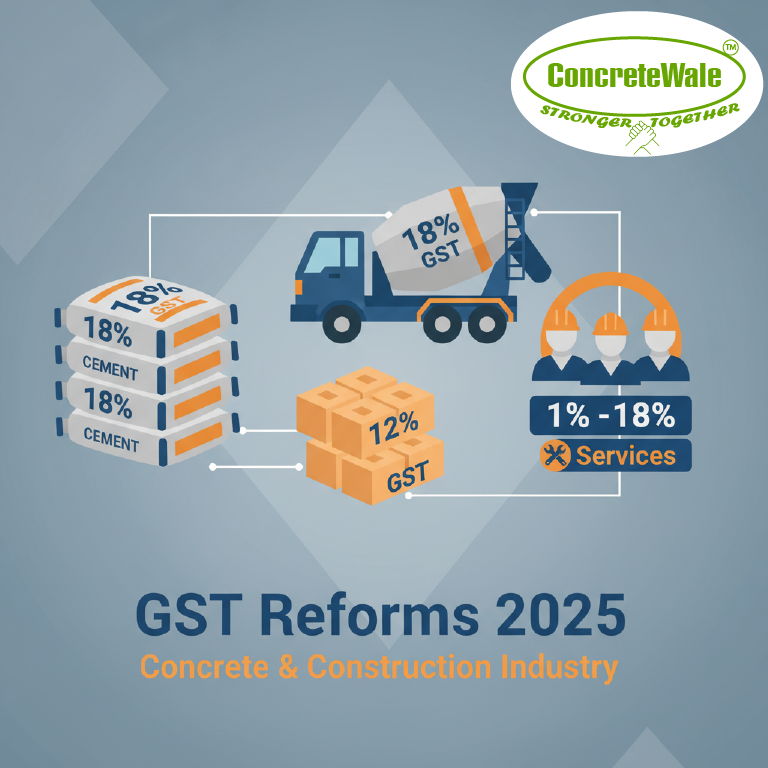
Cement has always carried a high tax rate because it’s considered a processed industrial product. However, in 2025, the government reduced its GST from 28% to 18% to support affordable housing and infrastructure projects. This rate applies to all common types of cement, including Ordinary Portland (OPC), Portland Pozzolana (PPC), and white cement.
Ready Mix Concrete (RMC) continues to attract 18% GST, as it falls under industrial production rather than a raw construction material.
Cement bricks, fly ash bricks, and AAC blocks now come under a unified rate of 12% GST (with input tax credit). Earlier, most of these products were taxed at 5%, but the new structure simplifies billing and ensures a uniform rate for all kinds of blocks and bricks.
Paving blocks, kerbstones, and decorative concrete tiles remain at 18% GST, since they are categorized as non-structural or aesthetic construction products.
The combined effect of these revisions is a moderate reduction in raw material costs, especially in large projects that consume high quantities of cement and blocks.
GST on Construction Chemicals and Admixtures
Concrete and construction chemicals continue to attract 18% GST. This includes waterproofing compounds, superplasticizers, curing agents, sealers, bonding agents, epoxy systems, and repair mortars.
These materials are treated as industrial-grade products, and their GST rate remains consistent because they are used in specialized applications rather than as general building materials. For contractors and RMC suppliers, this means input tax credit can still be claimed against sales or service outputs where GST applies.
GST on Concrete Machinery and Equipment
Machinery used in batching, mixing, or placing concrete attracts 18% GST. This covers batching plants, transit mixers, concrete pumps, vibrators, crushers, and similar equipment.
Even spare parts and attachments for such machines generally carry the same 18% rate. Imported machinery, however, comes with additional customs duty, making it important to calculate both taxes when budgeting for equipment purchases.
GST on Construction and Contract Services
The GST rates on construction services depend largely on the type of project and whether the contractor is availing input tax credit (ITC).
For affordable housing projects, the GST rate is 1% without ITC after accounting for the one-third land deduction.
For other residential projects, the rate is 5% without ITC. This also applies after the standard land deduction and is aimed at keeping home prices affordable for end buyers.
For commercial projects, the applicable GST can be 12% without ITC or 18% with ITC, depending on the chosen scheme. Developers or contractors working on projects with higher material involvement often opt for the 18% slab to take advantage of input credits.
Works contracts for government or local authority projects are generally charged at 12% GST, whereas large-scale infrastructure projects such as highways or public utilities may fall under 5% without ITC, as per their contract terms.
For pure labour or sub-contracting services where materials are not supplied, the GST rate is 18%, since it falls under the general taxable service category.
Input Tax Credit (ITC) in the Concrete Industry
One of the most valuable benefits of GST for this sector remains the ability to claim Input Tax Credit. Manufacturers, suppliers, and contractors can offset the GST they pay on raw materials and machinery against the GST they collect on sales or services.
For example, an RMC plant paying 18% GST on cement and admixtures can claim ITC when it sells RMC at 18%. Similarly, machinery and spare parts purchased at 18% can be credited against taxable supplies.
However, ITC cannot be claimed under schemes that are specifically marked “without ITC,” such as the 1% and 5% residential construction categories.
Why These GST Changes Matter
The 2025 reforms have brought several benefits to the concrete ecosystem. Lower GST on cement and bricks has reduced the overall cost burden on developers. The uniform 12% on blocks and bricks simplifies accounting and compliance.
At the same time, maintaining 18% on industrial items like RMC, admixtures, and machinery ensures fair tax collection from larger commercial players. For contractors and vendors, these revisions also improve clarity, allowing more accurate quotations and better cash flow planning.
GST continues to play a defining role in how India’s concrete and construction industry prices and manages projects. The 2025 updates have struck a better balance between affordability and fiscal discipline.
For anyone involved in cement manufacturing, RMC production, admixture supply, or construction contracting, staying aware of these rates is essential for correct billing, competitive pricing, and smooth compliance.
By aligning with the new GST slabs, businesses listed on Concretewale.com can maintain transparency and stay one step ahead in India’s growing infrastructure sector.
