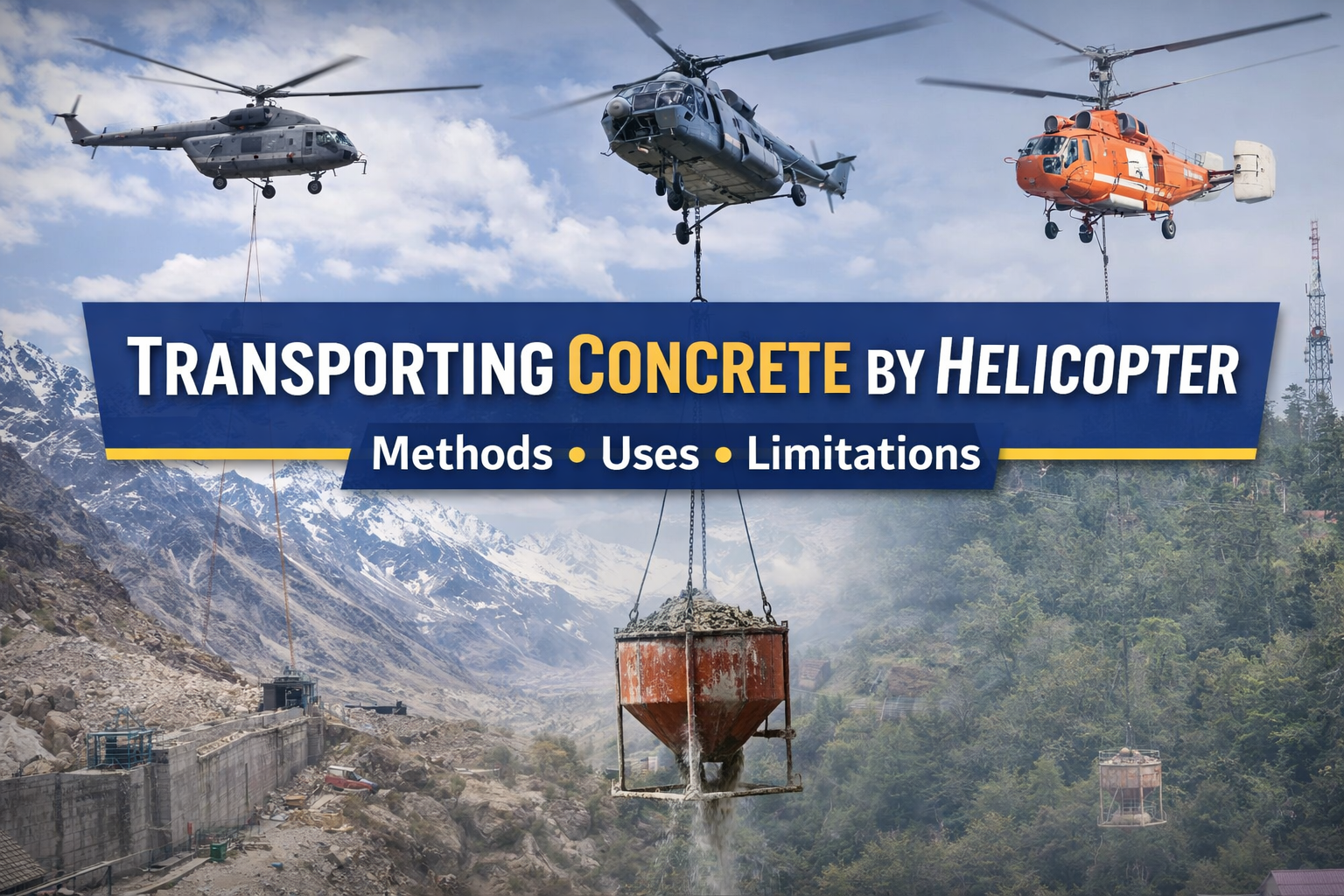
This method is used only in extreme conditions, such as:
1. High-Altitude & Mountain Construction.
a. Himalayan hydropower projects.
b. Remote bridges and culverts.
c. Border-area infrastructure.
d. Transmission towers on ridges.
2. Environmentally Restricted Zones.
a. Forest areas.
b. National parks.
c. Eco-sensitive zones where road construction is prohibited.
3. Island & Isolated Locations.
a. Small islands.
b. Lighthouse foundations.
c. Coastal or offshore installations (limited cases).
4. Emergency & Strategic Works.
a. Disaster recovery after earthquakes or landslides.
b. Defence-related infrastructure requiring rapid deployment.
How Concrete Is Transported Using Helicopters?
1. Sling Load Concrete Buckets.
Concrete is placed in:
a. Steel or composite concrete buckets/skips.
b. Fitted with secure lifting lugs.
c. Connected to the helicopter using certified sling cables.
The helicopter lifts the bucket from the batching area and flies directly to the pour location.
2. Typical Load Capacity.
a. Usually 0.5 to 1.5 cubic metres per trip.
b. Capacity reduces at higher altitudes due to thinner air.
c. Multiple trips are required even for small pours.
Concrete Mix Design Considerations (Critical)
Concrete used for helicopter transport must be specially designed.
Key requirements:
a. Controlled slump (not too wet, not too stiff).
b. Anti-segregation properties.
c. Set-retarding admixtures to prevent early setting.
d. Minimal free water.
e. High cohesiveness.
Poor mix design can lead to:
a. Aggregate segregation during flight.
b. Loss of strength.
c. Placement failure.
Types of Helicopters Commonly Used!
Depending on project scale and altitude, helicopters used include:
a. Mi-17 – Common in high-altitude and government projects.
b. Kamov Ka-32 – Excellent stability for precision lifting.
c. Bell 412 – Used for lighter loads.
d. CH-47 Chinook – Used internationally for large infrastructure works.
Concrete Placement at Site.
At the destination:
a. The helicopter hovers precisely.
b. The bucket is guided by trained ground crew.
c. Concrete is released immediately.
d. Manual or vibratory compaction follows.
Timing is critical—there is no margin for delay.
Advantages of Helicopter Concrete Transport !
a. Access to inaccessible terrain.
b. No need for road cutting or blasting.
c. Faster than building temporary access roads.
d. Minimal ground disturbance.
e. Enables construction where nothing else works.
Limitations & Challenges-
This method comes with serious constraints:
a. Extremely high operational cost.
b. Strong dependence on weather conditions.
c. Limited concrete volume per trip.
d. Risk of segregation if mix design is poor.
e. Strict aviation safety compliance.
f. Requires highly trained coordination teams.
Because of these factors, helicopter concrete transport is never economical for standard construction.
Is Helicopter Concrete Transport Used in India?
Yes—but very rarely.
In India, it has been used mainly for:
a. Himalayan hydropower projects.
b. Border Roads Organisation works.
c. Strategic and defence infrastructure.
d. Emergency restoration projects.
It is not used for residential, commercial, or urban infrastructure projects.
Sustainability Perspective.
From an environmental standpoint:
a. Reduces land damage by avoiding road construction.
b. Preserves forests and sensitive ecosystems.
c. But involves high fuel consumption.
So sustainability depends entirely on context and necessity, not marketing claims.
Cost Perspective (High-Level)
Helicopter concrete transport:
a. Costs multiple times more than conventional methods.
b. Is justified only when access creation costs exceed airlift costs.
c. Is evaluated on a project-specific basis, not per cubic metre alone.
Transporting concrete by helicopter is a last-resort engineering solution, used only when geography, regulations, or urgency leave no other option. While expensive and complex, it enables construction in locations that would otherwise remain unreachable.
For specialized infrastructure projects in extreme environments, helicopter concrete transport remains a vital—though rare—tool in modern construction engineering.