
Understanding Concrete Grade System: A Simple Guide for Everyone
When you see buildings, roads, or bridges being constructed, you might hear engineers talking about “M20,” “M25,” or “M30” concrete.
But what do these numbers mean? And why are they important? Let’s break it down in simple terms.
What is Concrete Grade?
Concrete grade is a way to classify the strength of concrete.
-
It is written as M followed by a number.
-
“M” stands for Mix and the number shows the strength of the concrete after 28 days of curing.
-
This strength is measured in N/mm² (Newtons per square millimeter) or MPa (Mega Pascal).
Example: M20 means the concrete will have a strength of 20 N/mm² after 28 days.
Why is Concrete Grade Important?
Choosing the right grade of concrete is like choosing the right material for clothes:
-
You won’t wear cotton in heavy rain, right?
-
Similarly, you cannot use weak concrete for high-rise buildings.
Each structure needs the right grade of concrete based on how much load it will carry.
-
Low grades → Suitable for simple, non-load bearing work.
-
High grades → Used for heavy-duty and long-lasting structures.
Types of Concrete Grades
Concrete grades are generally divided into three categories:
1. Ordinary Concrete Grades (M5 to M20)
-
M5, M7.5, M10 → Used for non-structural works like leveling, pathways, and flooring.
-
M15, M20 → Commonly used in simple reinforced concrete (like residential slabs, beams, small footings).
Example: In a small house, the flooring might use M10 or M15, while slabs and beams use M20.
2. Standard Concrete Grades (M25 to M35)
-
Stronger concrete, widely used in commercial and residential buildings.
-
M25 → A very popular grade, used in RCC (reinforced concrete) works such as slabs, beams, columns, and foundations.
-
M30, M35 → Used in structures that carry more load like bridges, pavements, and industrial buildings.
Example: Most modern apartments and office buildings use M25 or above.
3. High Strength Concrete Grades (M40 and above)
-
These are used in heavy-duty structures.
-
M40, M45, M50 → For bridges, high-rise buildings, heavy pavements.
-
M60, M70, M80, M100, M120 → Ultra-high strength concrete used in mega projects like dams, flyovers, and skyscrapers.
Example: Skyscrapers like Burj Khalifa use M80 grade concrete or higher.
Concrete Mix Ratio (Basic Idea)
Concrete is made by mixing cement, sand, aggregate (stone), and water.
The grade tells us the proportion of these materials.
-
M20 (1:1.5:3) → 1 part cement : 1.5 parts sand : 3 parts aggregate
-
M25 (1:1:2) → Stronger mix
-
Higher grades are designed with special calculations (called design mix) to achieve exact strength.
Everyday Examples to Understand Better
-
M10 → Like a weak wooden stool, enough to hold light weight.
-
M20 → Like a solid chair, strong for everyday use.
-
M40 → Like a heavy iron bench, very strong and durable.
-
M80 → Like a steel safe, extremely strong and built to last decades.
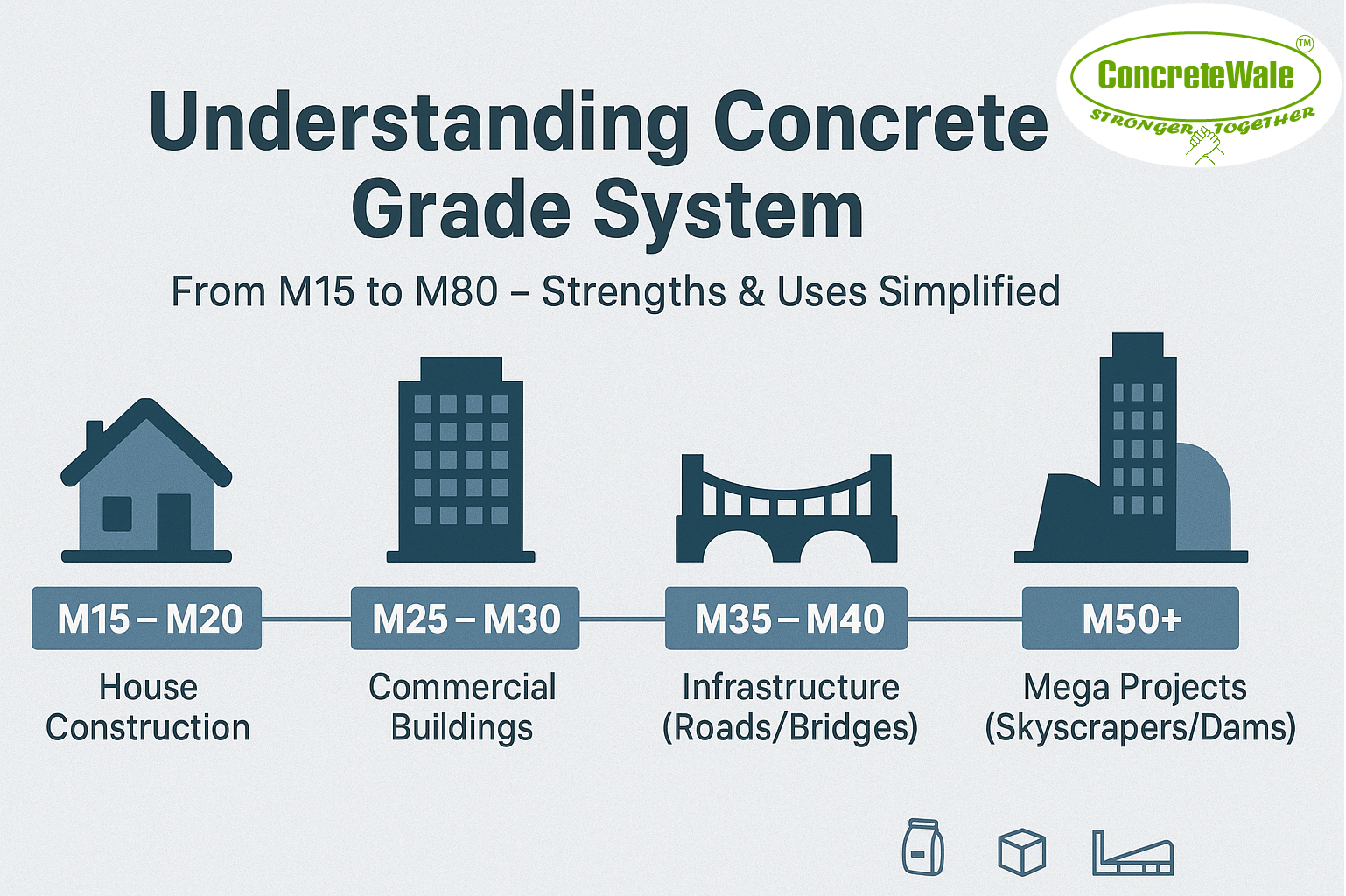
Concrete grade is not just a number – it decides the strength, durability, and safety of a structure.
-
Small house = M15 to M20
-
Apartments/Commercial buildings = M25 to M35
-
High-rise/Heavy structures = M40 and above
So next time you hear someone mention M20 or M25 concrete, you’ll know exactly what it means!
With the right concrete grade, our homes, offices, and cities stand strong, safe, and long-lasting.
