
Who Used Concrete First? The Great Debate on Concrete’s Origin!
Concrete — the backbone of modern civilization — is everywhere. From skyscrapers to highways, bridges to homes, it’s the material that literally holds our world together.
But have you ever wondered: who used concrete first?
The answer isn’t as simple as you might think. The history of concrete spans thousands of years and several civilizations, each contributing something unique to its evolution.
The Earliest Beginnings – Before Portland Cement
Concrete’s story begins long before factories, cement bags, and ready-mix trucks. Early civilizations discovered that mixing natural materials could create a strong, stone-like substance.
Egyptians (Around 2500 BC)
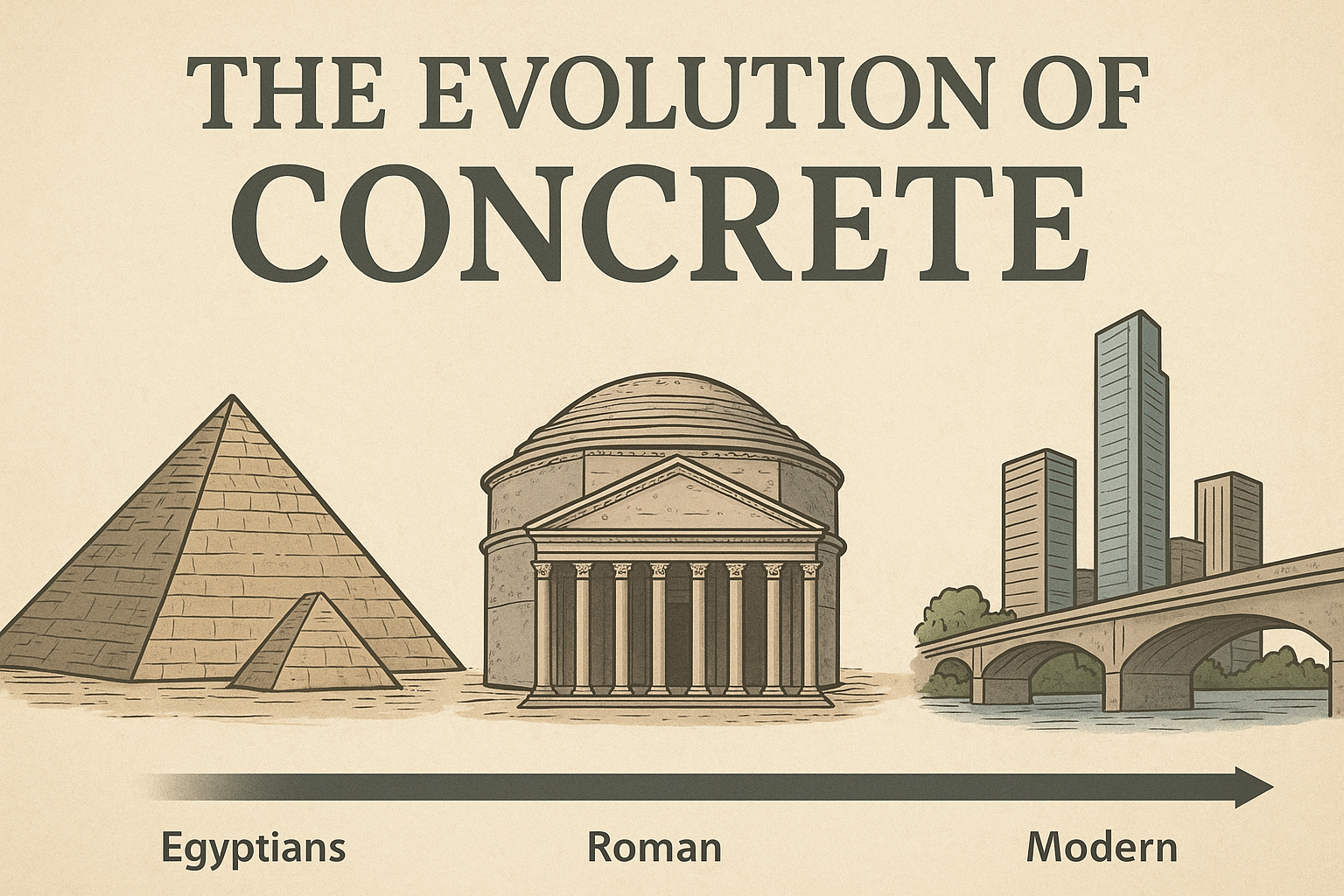
When building the great pyramids, the Egyptians used gypsum and lime mortars to bind massive stones together.
Some modern researchers believe the pyramid cores contain early limestone-based concrete, made by reconstituting soft limestone into blocks.
While this isn’t the same as modern concrete, it shows how ancient builders were already experimenting with binding materials.
Mesopotamians (3000 BC)
In ancient Mesopotamia, builders mixed clay and bitumen (natural asphalt) to create a waterproof material for walls and structures.
This wasn’t “true concrete,” but it demonstrated the earliest attempts to make strong, durable construction materials by mixing different natural ingredients.
The Greek Contribution
The Greeks, around 1000 BC, took a step closer by mixing lime, sand, and water to create stronger mortars.
However, they lacked one key ingredient — a material that could harden underwater, which limited their use to above-ground construction.
The Roman Revolution – True Concrete is Born
The real breakthrough came with the Romans.
Around 200 BC, Roman engineers began mixing lime, volcanic ash (pozzolana), and stones to create a revolutionary material called opus caementicium — what we now recognize as true concrete.
This mixture had hydraulic properties — it could set and harden even under water — which allowed the Romans to build monumental structures like:
-
The Pantheon (with the world’s largest unreinforced concrete dome)
-
Aqueducts
-
Harbors and piers that still survive today
Their concrete was incredibly durable, partly because of the volcanic ash from Pozzuoli near Naples, which reacted chemically with lime and water to form strong, long-lasting bonds.
Even after 2,000 years, Roman concrete continues to astonish modern engineers.
The Lost Knowledge
After the fall of the Roman Empire, the formula for pozzolanic concrete was forgotten for centuries.
Builders during the Middle Ages mostly used lime mortars, which lacked the strength and versatility of Roman concrete.
It wasn’t until the 18th century that the world began rediscovering how to make cement-based materials again.
The Birth of Modern Concrete
In 1824, an English mason named Joseph Aspdin patented Portland cement, named because it resembled Portland stone from Dorset, England.
This invention marked the beginning of modern concrete — the same fundamental mix we use today:
Cement + Aggregates + Water = Concrete.
This discovery transformed construction forever.
From that point onward, concrete became a global material — evolving with the addition of admixtures, reinforcements, and advanced machinery, leading to today’s high-performance concrete.
So, Who Used Concrete First?
In the earliest civilizations, around 3000–2500 BC, the Egyptians and Mesopotamians experimented with materials like mud, gypsum, and bitumen. These mixtures acted as primitive binders and helped them build monumental structures such as the pyramids and ziggurats. However, they weren’t true concrete — they lacked the chemical bonding and durability of what we know today.
Centuries later, between 1000 and 200 BC, the Greeks and Romans took construction to a whole new level. By combining lime, volcanic ash (pozzolana), and stones, the Romans created the first true hydraulic concrete — one that could harden even underwater. This innovation led to architectural marvels like the Pantheon and aqueducts that still stand strong after two millennia.
Finally, in 1824, the modern age of concrete began when Joseph Aspdin, a British mason, patented Portland cement. His formula produced a material that resembled natural Portland stone — and it became the foundation of all modern concrete. From this point onward, concrete as we know it today — made from cement, aggregates, and water — took shape and revolutionized global construction.
The Final Verdict
-
Egyptians – Early use of lime and gypsum mortars.
-
Romans – Inventors of true concrete, still admired today.
-
Joseph Aspdin (UK) – Creator of modern concrete using Portland cement.
Each civilization played a part, but the Romans are most often credited with developing the first real concrete — and Joseph Aspdin with giving us the modern version we build with today.
Concrete’s journey from ancient lime mortars to high-tech admixtures is one of human innovation and persistence.
It’s a story that connects the pyramids of Egypt, the dome of the Pantheon, and the skyscrapers of today.
And at Concretewale.com, we celebrate that journey every day — by bringing together all things concrete under one roof:
from products and machinery to manpower and technology.
