Light generating Concrete
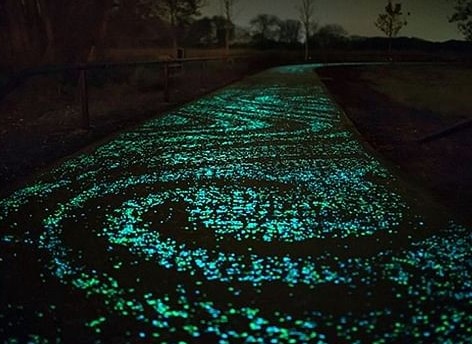
Light-emitting Concrete is a green construction material designed to illuminate highways, roads, and bicycle lanes without using electricity. Light-emitting concrete absorbs solar energy during the day and radiates light at night
This innovative concrete was developed by Dr. Jose Carlos Rubio from the Michoacan University of Saint Nicholas of Hidalgo in Mexico. The research focused on modifying the microstructure of cement to absorb solar energy and emit light in darkness.
Principle of Light-Emitting Concrete
Concrete is an opaque material that does not allow light to pass through its interior. When water is added to concrete, crystal flakes are formed as a result of hydration reaction. These crystals block the absorption of solar energy.
The researcher's main objective was to modify this microstructure of concrete to eliminate the crystals so that the incoming light can penetrate deep into the concrete or concrete structure. The concrete is also made phosphorescent so that the solar energy is absorbed and released.
The light-emitting concrete, when combined with water, changes completely to gel form so that it absorbs solar energy and releases it in the form of light.
In the day time, the light-emitting concrete structure acts as a storage device. During this time, the whole mass is soaked in sunlight, and the electrons within the mass are in an excited state. During the night, these electrons return to their original state due to which light is emitted. This concrete can provide light continuously for 12 hours without the use of electricity.
Most fluorescent materials made out of plastic normally have a life of three years. They decay with the absorption of ultraviolet rays. But Dr. Rubio claims light-emitting concrete is a sun-resistant concrete that has a life of 100 years.
When used in highways, the intensity of light emitted by the concrete can be regulated to avoid unnecessary glare for the drivers and cyclists.