
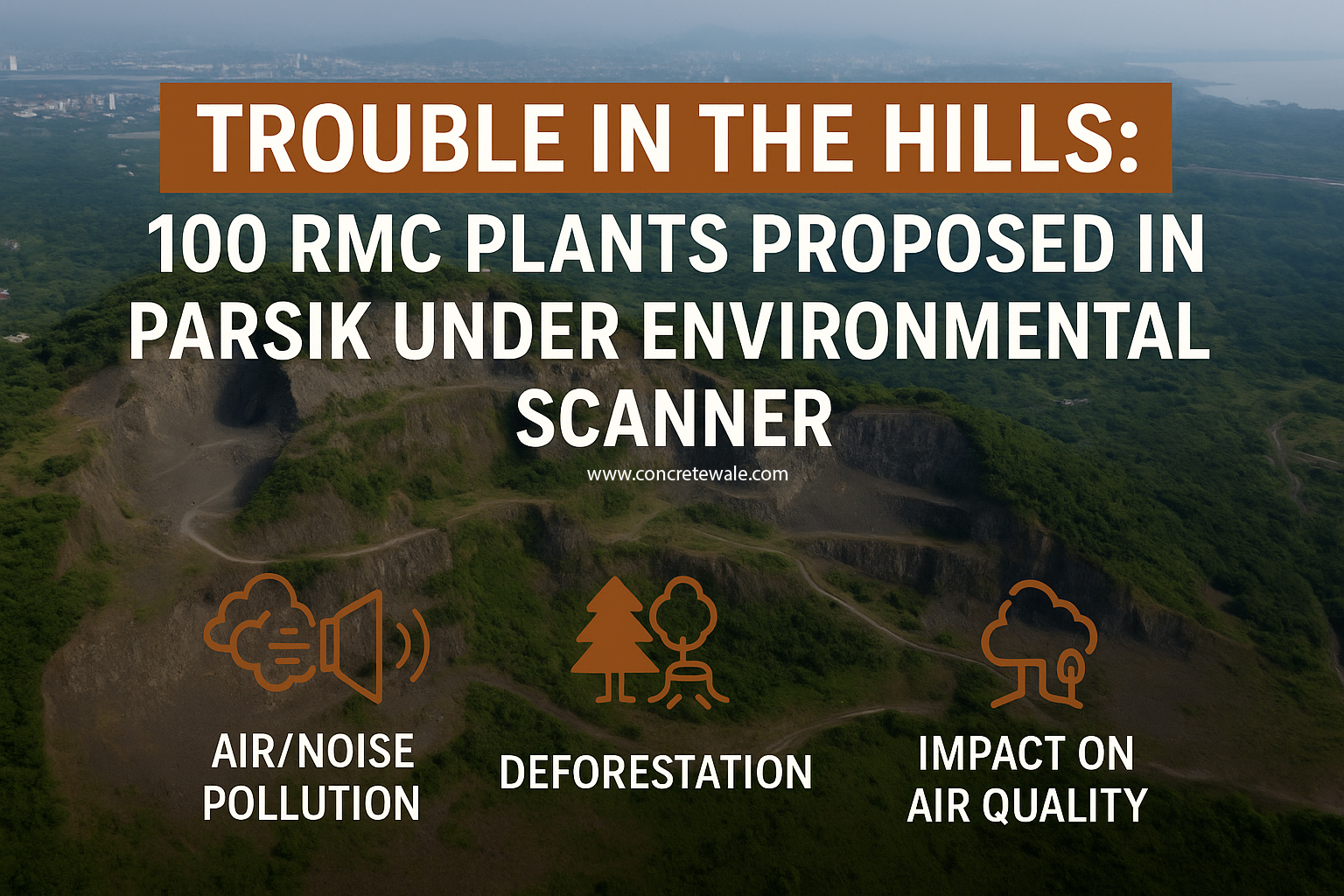
Trouble in the Hills: 100 RMC Plants Proposed in Parsik Under Environmental Scanner
Navi Mumbai, Maharashtra
What happens when development and environment go head-to-head?
That’s the hot debate currently brewing in Navi Mumbai, where a proposal to set up around 100 ready-mix concrete (RMC) plants at the old stone quarries of Parsik Hill has raised red flags among environmentalists, citizens, and even government authorities.
The proposed project is now under federal investigation, following concerns about deforestation, rising air and noise pollution, and the overall impact on the fragile hill ecosystem.
What’s the Proposal?
The Navi Mumbai Municipal Corporation (NMMC) and several private operators have floated a plan to set up around 100 RMC units on lands previously used for quarrying on Parsik Hill—a hill range stretching across Belapur to Mumbra.
These sites, once cleared out by heavy stone mining (now officially banned), are being eyed for reuse by construction and infrastructure companies, banking on the existing open spaces and proximity to urban hubs.
Why Are People Opposing It?
While developers argue this would bring jobs, speed up local construction projects, and utilize already-disturbed land, environmental groups are sounding the alarm.
Here are the key concerns:
- Air Pollution: RMC plants produce significant cement dust and particulates. Residents fear a sharp decline in air quality, especially in nearby residential areas like CBD Belapur, Kalwa, and Ghansoli.
- Noise Pollution: The operation of mixers, transport trucks, and material crushers can be extremely noisy, especially if plants run round the clock.
- Deforestation Risks: Although these are former quarry zones, several patches have naturally reforested over the years. Activists say new construction would wipe out regrowth and impact wildlife corridors.
- Water & Drainage Issues: The hill’s slopes are crucial for water runoff. Laying concrete bases and plants here may disrupt local water flow and increase flood risks during monsoons.
Government Steps In
Following pressure from citizens, green activists, and media coverage, the Forest Protection Division and Maharashtra Pollution Control Board (MPCB) have launched a joint investigation. They’ve requested details from:
- The quarry leaseholders
- NMMC's town planning department
- Environmental clearance records
No formal clearances have yet been issued for these plants, but several sites are reportedly under preparation, which has intensified scrutiny.
A senior official from the MPCB stated:
“We are reviewing whether proper environmental impact assessments (EIA) were conducted. If not, these activities will be considered illegal.”
What Locals Are Saying
Residents of Kalwa and Belapur have started signing online petitions and organizing awareness drives. “We’re not against development,” said Meena Joshi, a local teacher, “but not at the cost of our lungs and our hills. We want sustainable decisions, not shortcuts.”
What It Means for the Concrete Industry
If approved, these plants would significantly boost RMC availability in Navi Mumbai and parts of Thane. For builders and contractors, this means lower transport costs, faster deliveries, and more consistency in supply.
But if denied, it could set a major precedent for how land reuse in environmentally sensitive areas is governed in India—a key issue as urban sprawl continues.
The Parsik Hill RMC plant debate is not just a local issue—it’s a reflection of the national dilemma: how do we balance infrastructure growth with ecological responsibility?
The coming weeks will likely decide the future of this proposal. Whether it's scrapped, modified, or greenlit with stricter checks, one thing is clear: India's concrete growth needs a greener conscience.
